One method, applied where being wrong is expensive
We build systems that catch what would otherwise get through — a gap in a scope, an unsupported claim in an AI’s answer, a fall in a room where someone lives alone. Different problems, one method.
What we’ve built with it
Each product points the same engine at a different body of evidence — the open web, your own contracts, or a live sensor in a room.
An independent check on the AI you already use. Ask Claude or Perplexity to verify a claim and get a verdict traced to real sources — judged by models from a different lab than the one that answered.
Try it free → Pilot engagementsValidate project scope against thousands of comparable deployments. Catch gaps before they become change orders.
Talk to us → Pilot engagementsScope to signed statement of work to scheduled work to the matching invoice — on whichever structure you bill under. Each document is checked against the one before it.
Apply for the pilot → Pilot engagementsThe same idea sized for the one-person service business. From the scoping conversation to the paid invoice, with the estimate checked against what was said and the invoice against what the customer accepted.
Apply for the pilot → In developmentUnderstand what you're actually signing. Noevant flags pricing anomalies, hidden terms, and renewal traps.
Learn more → In developmentSurface technology risk before close. Stack assessment, license exposure, integration complexity — all in one view.
Learn more → In developmentPhysical-world intelligence for aging in place — a passive edge-AI alerting platform that watches the home and reaches a circle of family until someone responds.
Learn more →A note on the names
Noevant, Fidenta and Succura are coined words, and Condicta is taken straight from Latin, so here is where they come from. It is a rule we hold ourselves to rather than a flourish: if a thing needs a name rather than a description, the name comes from an old word for knowing, trusting, agreeing or helping — and the product then has to earn it.
Noevant — two words pushed together. Noe— from the Greek νοέω (noeō), to perceive or apprehend with the mind, from νοῦς (nous), mind. —vant from savant, the French present participle of savoir, to know, which traces to the Latin sapere — a verb that first meant to taste and only later to be wise. Knowing by discernment, in other words, rather than by assertion. Which is the whole job.
Fidenta — from the Latin fidēns, trusting or confident, the present participle of fīdō, to trust; the same family as fidēs — trust, faith, reliability. Fides was also a Roman goddess, one of the original virtues raised to a divinity, and specifically the protector of promises made between parties: to break faith with someone was an offence against her. A tool that checks whether a claim keeps its promise could not really be called anything else.
Succura — from the Latin succurrere, to run to someone’s aid, built from sub— (under, up to) and currere (to run). It is the root English took for succour. Caesar uses it in the Gallic War of a soldier who runs to help a man he personally disliked. Not watching, not logging — running.
Condicta — the plural of the Latin condictum, an agreement or an appointment. It comes from condīcō, to agree upon, to promise, to fix, built from con— (with, together) and dīcō (to say, speak). Things settled by talking them through — which is how most service work gets scoped, and why the record starts with the conversation.
The product names are plain on purpose. Scope Intelligence and Vendor Contract Analysis say what they do, and a name that needs explaining should be doing more work than that.
Why one method covers all of it
In each case something arrives looking finished — a scope, an answer, a quiet house — and the expensive failure is the thing nobody checked.
A scope is a set of assumptions presented as a plan. An AI’s answer is a set of claims presented as fact. A quiet house is an absence of evidence presented as reassurance. All three reward the same discipline: break it apart, look for evidence outside the thing itself, get a second independent read, and stay honest about the difference between no problem and no data.
That last part is why a sensor product and a software product share a spine. Succura’s hardest engineering problem is not noticing a fall. It is not calling a family at three in the morning because someone sat down quickly — the same restraint that stops Fidenta Verify calling a true statement a lie.
How we engage
The products above stand on their own. When the problem is bigger than a tool, these are the two ways we work.
AI governance assessments, guardrail builds, and fractional oversight for services firms and mid-market regulated businesses.
Explore consulting →Need something custom? We build production AI that encodes your experts' judgment — the same way we built our own tools.
See what we've built →Scope Intelligence
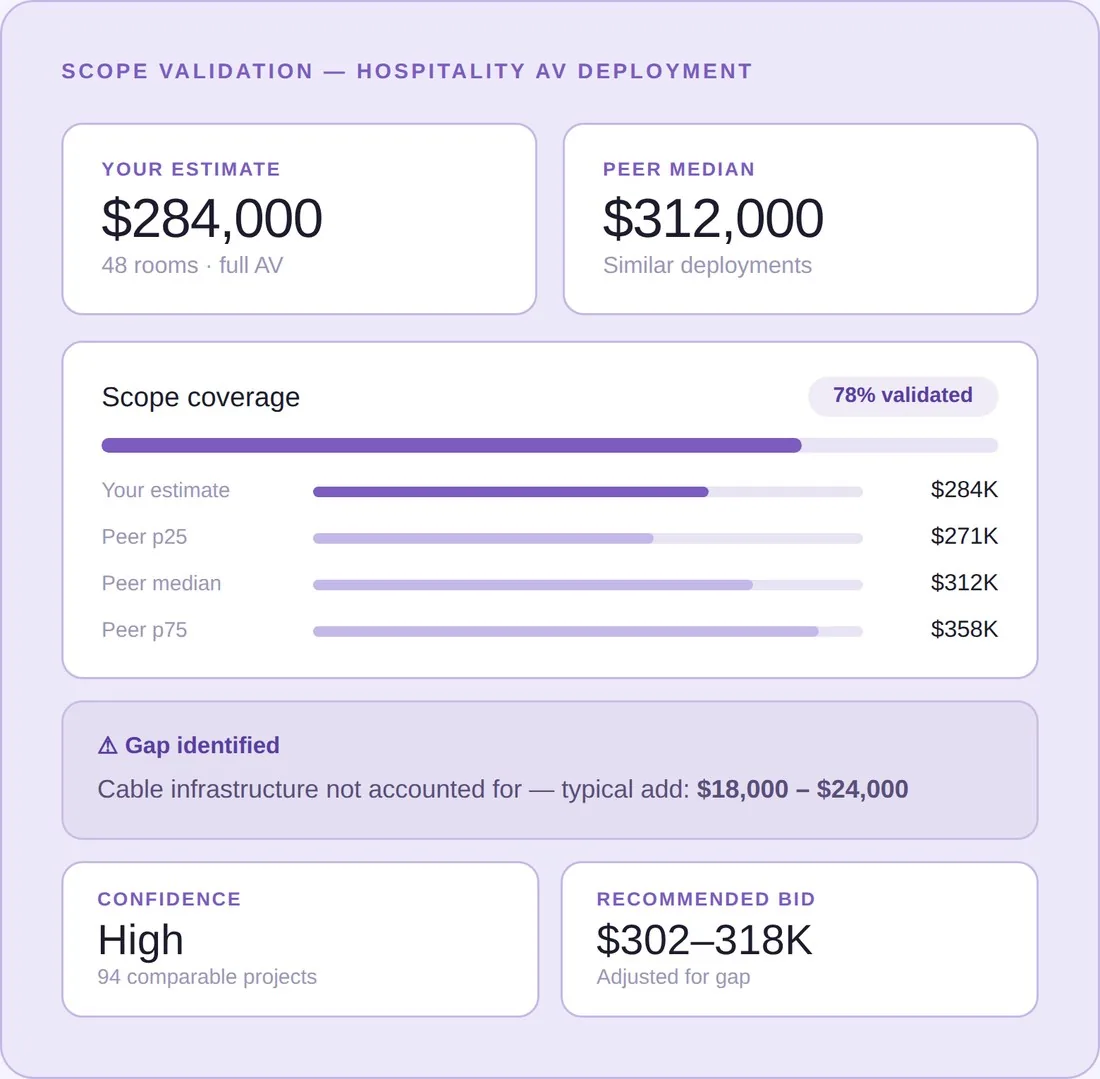
Most technology integrators underbid because they're working from instinct, not data. Noevant compares your scope against a live database of real-world deployments — and your own previous deployments — so you know where you're exposed before you submit the proposal.
Fidenta Verify — available now
Fidenta Verify takes a claim, searches the live web for evidence, and returns a verdict with the sources behind it. The model that assesses the evidence comes from a different lab than the one that produced the answer — because a model checking its own work is not a check.
It also says “we searched and found nothing” when that is the honest answer, instead of calling it false. That distinction is the whole point.
Connect it to Claude or Perplexity in about two minutes. 40 claim checks free to start, then 10 every month — no card. One credit checks one claim.
The method
A confidence number tells you how sure a model is, which is not the same as whether something is true. Every Noevant product does the same four things instead.
A paragraph, a scope, a contract — none are true or false as a whole. The statements inside them are. So we split first and check each on its own.
Not the model’s memory. Real sources, retrieved at the moment of asking, from more than one place, so a single bad source cannot decide the answer.
A model reviewing its own work is not a second opinion. A model from a different lab, with different blind spots, audits every verdict before you see it.
Supported, contradicted, unsupported, or unverifiable. “Not found” is not “false” — and a system that treats them the same will eventually call something true a lie.
Ready to know what others miss?
No credit card required.
Get started todayGet started
